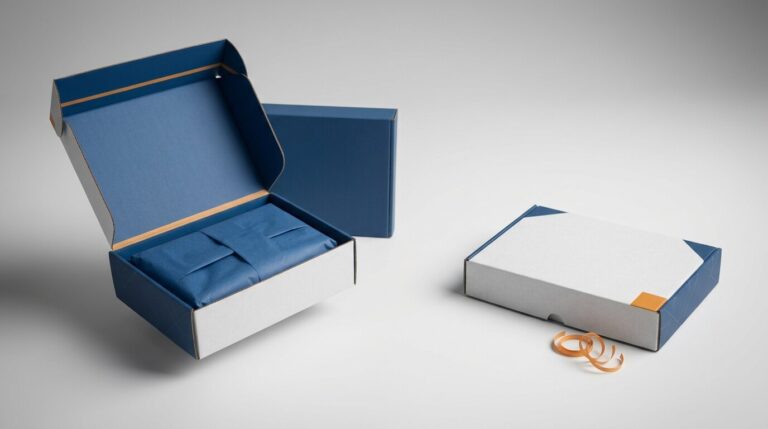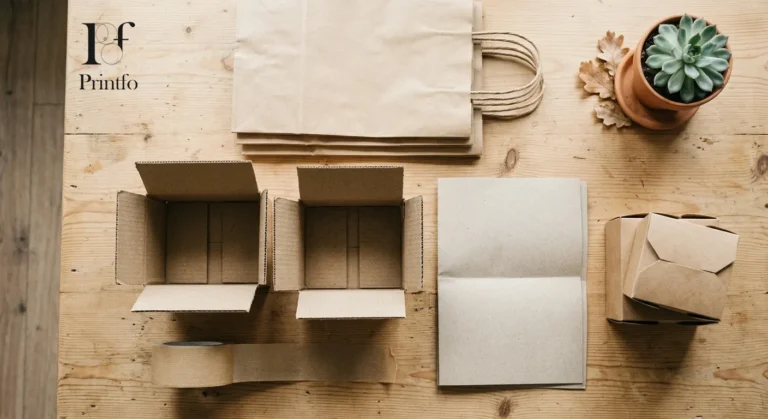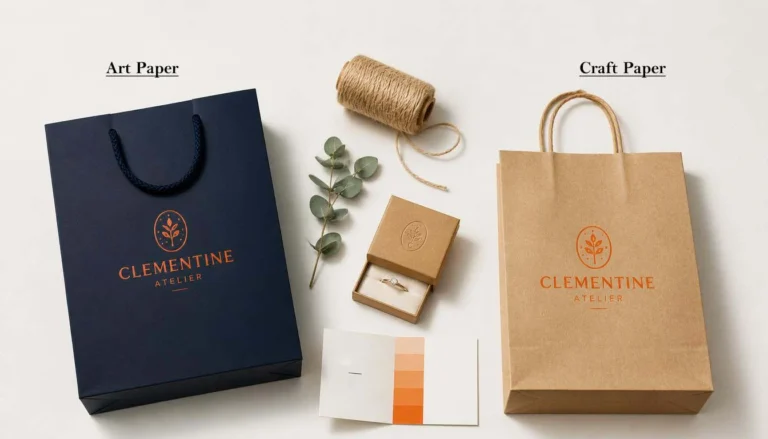


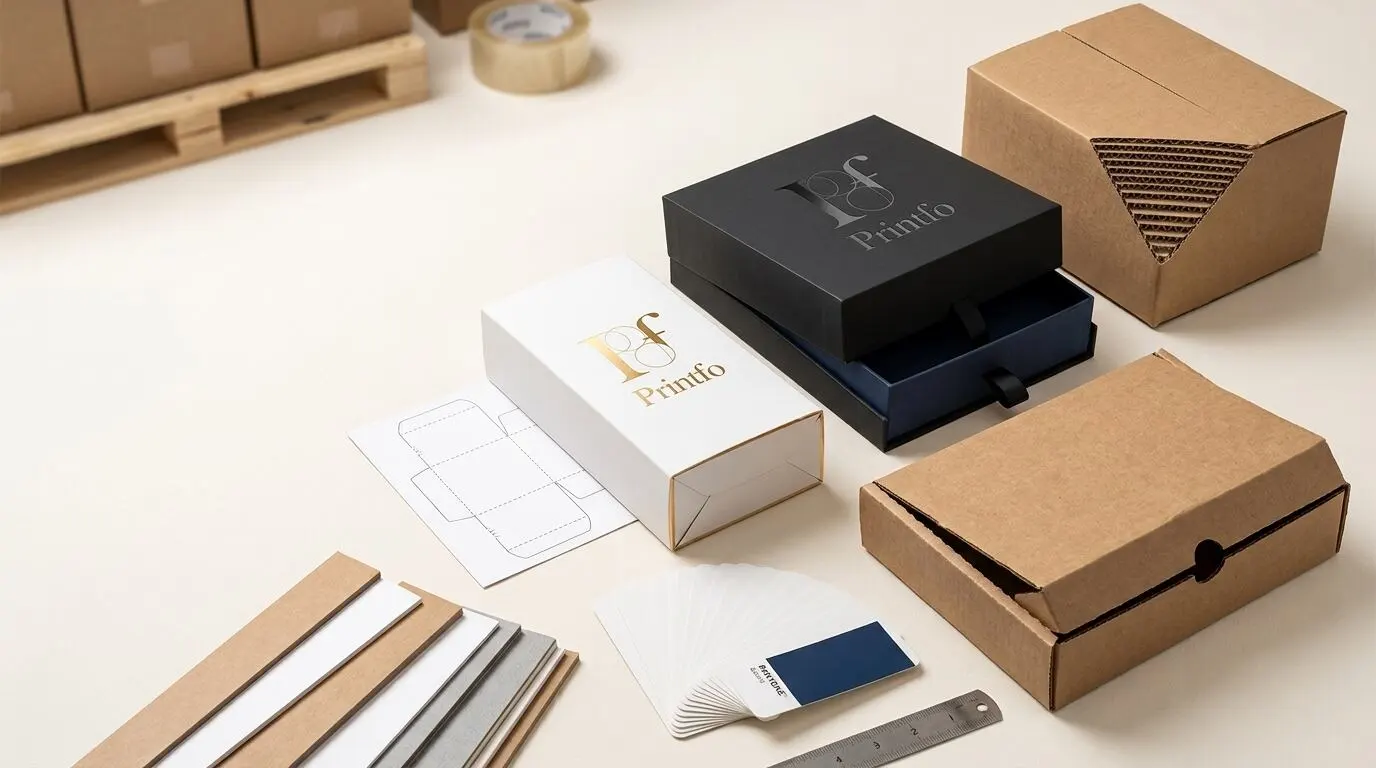
Custom packaging is a box, carton or bag made to fit your product and carry your brand. When you customize box packaging, you make five choices: the box type, the material, the printing method, the finish and the quantity. Those choices decide how the pack looks, how well it protects the product and what it costs.
This guide covers each choice. Folding cartons suit light retail products. Corrugated boxes suit shipping. Rigid boxes suit gifts and high value items. At Printfo, we make boxes from kraft paper, art card, Swedish board (300 or 350 gsm), duplex board and corrugated fiberboard. We print on offset and digital presses, and we match your brand color with a Pantone code. Our finishes are matte and gloss lamination, spot UV, embossing, debossing, foil stamping and soft-touch coating.
Price depends on size, paper thickness, lamination, colors and quantity. Our starting prices run from about $0.16 for a simple kraft paper box to about $4.07 for a duplex board box. An order moves through quotation, payment, printing and delivery, and we ship worldwide. On overseas orders, plan for roughly 4 to 8 weeks or more, depending on finishes and shipping method.
| Question | Short Answer |
| Which box suits light retail products? | A folding carton in Swedish board, art card, or kraft paper. |
| Which box suits shipping? | A corrugated mailer or shipping box. |
| Which box suits gifts and high value items? | A rigid box. |
| Which materials do we use? | Kraft paper, art card, Swedish board (300 and 350 gsm), duplex board, and corrugated fiberboard. |
| How do I match my brand color? | Give us a Pantone code. |
| Which finishes are available? | Matte and gloss lamination, spot UV, embossing, debossing, foil stamping, and soft-touch. |
| What does a box cost at Printfo? | About $0.16 to $0.81 (kraft paper), $0.24 to $0.98 (Swedish board), and $0.81 to $4.07 (duplex board) per piece. |
| What changes the price? | Size, paper thickness, lamination, colors, and quantity. |
| How long does an overseas order take? | Roughly 4 to 8 weeks or more. |
| What should I send for a quote? | Box style, size, material, print, finish, quantity, destination, and deadline. |
What custom packaging means
Custom packaging is packaging made for one product and one brand. You choose the size, strength, print and finish.
There are three levels. A stock box is a plain box in a standard size. A printed stock box is a standard size with your logo on it. A fully custom box has its own size, structure and print. Stock boxes are cheapest and fastest. Fully custom boxes fit better and show more of your brand, but they cost more up front.
You will also see three packaging layers. Primary packaging touches the product, like a cosmetic carton. Secondary packaging groups primary packs, like a display box that holds twelve cartons. Tertiary packaging protects goods in transport, like a master carton or a wrapped pallet. This guide covers primary and secondary boxes. For other formats, read our guides to custom paper shopping bags, paper tube packaging and stand-up pouches and poly mailers.
Start with your product, not the box
Six questions pick most of the box for you. Answer them before you look at styles.
- How much does the product weigh?
- Can it break or get crushed?
- How will it travel: by parcel, on a pallet or straight to a shelf?
- Who will handle it: a courier, a shop assistant or your customer?
- What first impression do you want: plain and practical, or gift quality?
- How many boxes do you need, and what is your budget?
This table turns your answers into a starting point.
| Your situation | Good starting point |
|---|---|
| Light cosmetic or supplement sold on a shelf | Folding carton in Swedish board or art card |
| Online order, light to medium weight | Corrugated mailer (E or B flute) |
| Heavy or fragile shipment | Corrugated shipping box (C flute or double wall) |
| Gift set or high value item | Rigid box |
| Plain stock box that needs branding | Printed sleeve |
| Product sold in shops and also shipped | Carton inside a corrugated shipper |
A box that looks great on a shelf can fail in a parcel. If your product ships, send a test parcel before you order thousands.
Custom box types compared
Most custom boxes fall into three families: folding cartons, corrugated boxes and rigid boxes. Sleeves and display boxes add two more options.
| Type | Typical material | Strength | Print quality | Ships flat | Cost tier | Best for |
|---|---|---|---|---|---|---|
| Folding carton | Swedish board, art card, duplex board, kraft paper | Low to medium | Excellent | Yes | Low to medium | Light retail products |
| Corrugated mailer | Corrugated fiberboard (E or B flute) | Medium to high | Good | Yes | Low to medium | Online orders |
| Corrugated shipping box | Corrugated fiberboard (C flute or double wall) | High | Fair to good | Yes | Low | Heavy or fragile shipments |
| Rigid box | Thick board wrapped in printed paper | High | Excellent | No | High | Gifts, electronics, luxury items |
| Sleeve | Card or paperboard | Low | Excellent | Yes | Low | Branding a plain box |
| Display box | Corrugated or card | Medium | Good | Yes | Medium | Counter and shelf displays |
Cost tier compares box types. It does not compare suppliers.
Folding cartons
A folding carton is one layer of paperboard that is cut, creased and folded. It ships flat and prints very well, so cosmetics, supplements and small electronics often use it. There are three common styles. A straight tuck end carton has both flaps folding toward the back. A reverse tuck end carton has flaps that fold in opposite directions. An auto-bottom carton has a base that snaps into place when you open it. Folding cartons are light, so pack them inside a stronger outer box for shipping.
Corrugated mailers and shipping boxes
Corrugated board has a wavy layer between two flat sheets. The wavy layer gives the box its strength. A mailer has a lid that tucks into the box, and it is popular for online orders. A shipping box has flaps on the top and bottom.
FEFCO codes name these styles the same way in every country. A code has four digits. The first two show the style family, and the last two show the exact style. FEFCO 0201 is the standard box with flaps on top and bottom. FEFCO 0427 is the roll-end mailer with a locking lid. The code does not include size, so you give the length, width and height separately. When you ask for a quote, the code is the fastest way to say which box you mean.
Rigid boxes
A rigid box is thick board wrapped in printed paper. It does not fold flat. It ships fully built, takes up more space and costs more. People choose it for gift sets, electronics and jewelry, where the box is part of the product. Common styles are the two-piece lid and base, the magnetic closure box, the shoulder-neck box and the book-style box. The board is often about 1.2 to 2 mm thick (about 0.05 to 0.08 inch).
Sleeves, display boxes and inserts
A sleeve is a printed band that slides over a plain box. It is the cheapest way to brand a stock box. A display box is a carton that opens into a small counter or shelf display. An insert is a card or corrugated tray that holds the product still inside the box.
For a closer side-by-side of the three main families, read our guide to rigid boxes vs folding cartons vs corrugated boxes.
Materials: what your box is made of
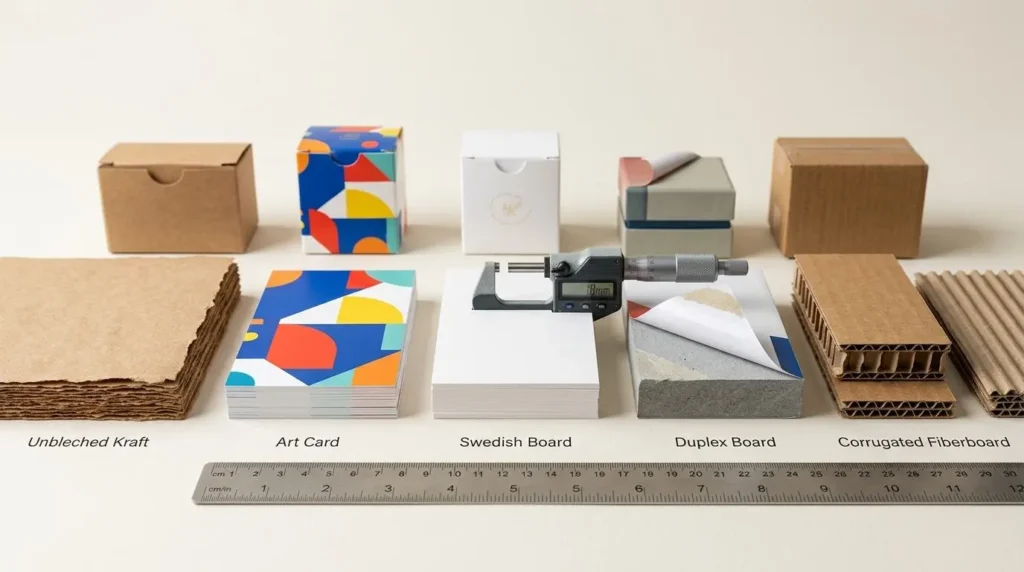
The paper you choose sets the strength, the print quality and a large part of the price. At Printfo, we make boxes from five materials.
| Material | What it is | Best for | Note |
|---|---|---|---|
| Kraft paper | Brown, unbleached paper or board | Apparel, gifts and natural-look brands | Lowest price range. Colors print darker on brown, so ask for a Pantone swatch. |
| Art card | Coated card with a smooth surface | Light cartons, sleeves, tags and inserts | Prints sharp images and fine text. |
| Swedish board | Bright white, stiff solid bleached board | Cosmetics, supplements, retail cartons, foil and embossing | Creases cleanly and holds its shape. |
| Duplex board | Board coated on one side with a grey recycled back | Sturdy cartons and boxes with a printed outside | Prices cover a wide range because thickness and finish vary. Ask about white-back options if the inside matters. |
| Corrugated fiberboard | Fluted layer between two flat liners | Shipping boxes and mailers | Pick the flute to match the load. |
Swedish board: 300 gsm or 350 gsm?
Swedish board is a bright, stiff solid bleached board. GSM means grams per square meter, so a higher number is heavier and thicker. A 300 gsm sheet is about 330 to 345 microns thick (a micron is a thousandth of a millimeter). A 350 gsm sheet is about 400 to 415 microns. Thickness varies a little from mill to mill.
Use 300 gsm for light products such as lip balm or small supplement boxes. Use 350 gsm for larger or heavier cartons, such as a perfume box or a gift set, because the extra thickness holds its shape better. If you are not sure, ask for a sample of each. A box in your hand tells you more than a number on a sheet.
Duplex board: how hard paper boxes are made
Duplex board is a hard, stiff board. For packaging, it comes in thicknesses from about 0.28 mm to 0.55 mm (about 0.011 to 0.022 inch). It holds its shape well, so it makes the sturdiest paper boxes.
For hard boxes, we use a two-step method. First, we print your design on art paper, using an offset or digital press. Then we wrap the printed paper smoothly around the duplex board with gum. The result is a box with a hard body and a clean, even surface.
This is how the hardest paper boxes are made. The duplex board gives the box its strength, and the art paper carries the print. A thicker board makes a stiffer box, so ask for a sample if you are not sure which thickness you need.
Corrugated flutes
The flute is the wavy layer inside corrugated board. Its size changes how thick, how strong and how smooth the box is. The numbers below are approximate, and they vary by maker.
| Flute | Thickness | Flutes per foot (about 300 mm) | Best for |
|---|---|---|---|
| F | 0.8 to 1.2 mm | 125 to 128 | Small cartons and fine print |
| E | 1 to 1.6 mm | About 90 | Printed mailers and light retail boxes |
| B | 2.5 to 3 mm | 47 to 49 | Mailers, die-cut cartons and stacking |
| C | 3.2 to 4.5 mm | 38 to 41 | General shipping cartons |
| A | 4.8 to 5 mm | 33 to 36 | Extra cushioning |
| BC (double wall) | 5 to 6 mm | Two layers | Heavy freight |
Smaller flutes give a smoother surface for print and a thinner box. Larger flutes cushion and stack better. Many printed mailers use E or B flute. Many shipping cartons use C flute. Heavy freight often uses double wall board.
Ask how a supplier states box strength. Edge crush test (ECT) measures how well the board resists stacking pressure. Box compression test (BCT) measures the finished box. Check which one a quote uses.
Other board names you may see in quotes
Other suppliers use different names. Solid bleached board (SBS) is bright white and stiff, and Swedish board is usually this type. Folding box board (FBB) is built from layers of different pulp. It is bulky and stiff, typically 200 to 350 gsm. Coated recycled board is a lower cost grade with weaker print quality, and it is common for dry food and non-food products. Our guide to packaging board types compares them in more detail.
Recycled and FSC options
FSC certified board comes from responsibly managed forests. If a supplier says a box is FSC certified, ask for the certificate number and look it up in the FSC certificate database. We offer eco-friendly material options, and you can ask us for a certificate number too.
How to choose a material
| If you care most about | Choose |
|---|---|
| Sharp print and a bright white look | Swedish board or art card |
| A natural, low cost look | Kraft paper |
| Strength in shipping | Corrugated fiberboard |
| A sturdy box with a printed outside | Duplex board |
Our post on art paper vs kraft paper goes deeper on two of these choices.
Printing methods without the jargon
Digital printing suits short runs. Offset printing suits large runs. We run both, so you can choose by quantity.
| Method | Best for | Setup | Limits |
|---|---|---|---|
| Offset | Large runs, fine detail, spot colors | Plates needed, so more setup | Costs more per piece on small runs |
| Digital | Short runs and fast turnaround | No plates | Can cost more per piece on big runs |
| Flexo | Very large corrugated runs | Plates needed | Struggles with gradients and photos |
Flexo is a method other suppliers often quote for corrugated boxes. It is in the table so you can compare quotes. Our guide to offset vs digital printing explains the cost difference in more detail.
Exact color matching with Pantone
We offer Pantone color code matching, so your brand color prints the way you expect.
CMYK builds every color from four inks: cyan, magenta, yellow and black. Some brand colors, like a bright orange or a deep blue, sit outside what those four inks can mix. Pantone is a color library. Each color has a code, and each code is a pre-mixed ink. When you give a Pantone code, the printer matches that exact ink instead of blending it from four.
To use it, send the code with its letter, such as PANTONE 186 C. The letter tells the printer whether the color is for coated or uncoated paper. The same code can look different on kraft paper, art card and uncoated board, because the paper color and surface change what you see. Check a printed swatch or a press proof before the full run.
Before printing, our pre-press team also checks your file for color profile, resolution and bleed margins. To learn more, read about the CMYK printing process, Pantone vs CMYK and print-ready files.
Finishes: what they do, what they cost, what they do to recycling
Finishes change how a box looks and feels, and they protect the print from scuffs. They do not make the box stronger. The board decides strength.
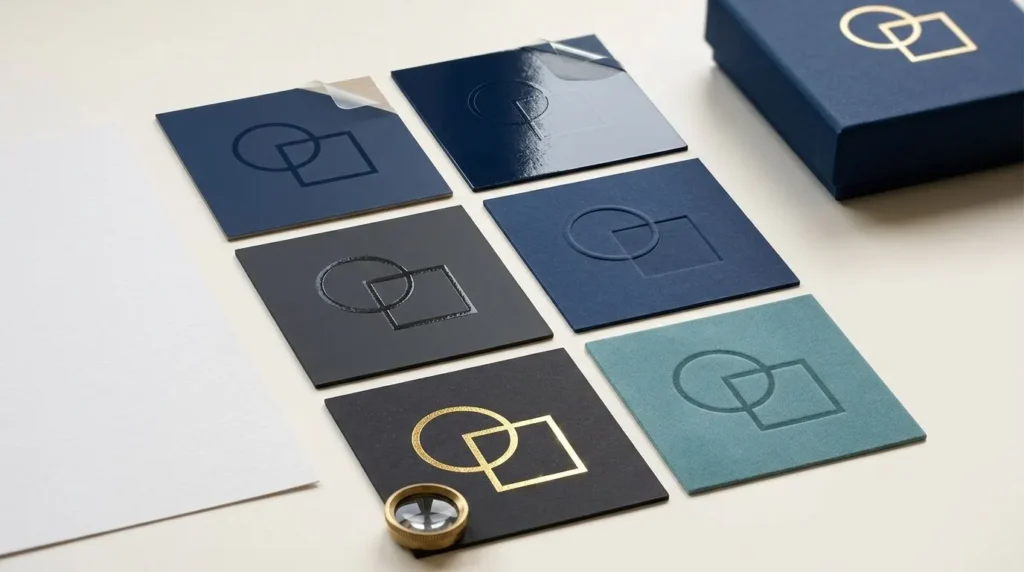
We offer matte lamination, gloss lamination, spot UV, embossing, debossing, foil stamping and soft-touch coating.
| Finish | Look and feel | Best for | Typical market add-on per box | Recycling note |
|---|---|---|---|---|
| Matte lamination | Flat, low shine, smooth | A modern, calm look | $0.05 to $0.50 | A plastic film layer can make recycling harder. Ask what film is used. |
| Gloss lamination | Shiny, bright colors | Bold, colorful designs | $0.05 to $0.50 | Same as matte lamination. |
| Spot UV | Glossy coating on chosen areas | Logos and patterns on a matte base | $0.10 to $0.60 | Small spots matter less than full coverage. |
| Embossing and debossing | Raised or pressed-in pattern | Logos and textures | $0.20 to $0.60 | No extra material is added. |
| Foil stamping | Thin metallic shine | Logos and fine lines | $0.30 to $0.70 | Depends on the foil type and the area covered. Ask for test data. |
| Soft-touch coating | Velvet-like feel | Gift boxes and cosmetics | $0.12 to $0.25 | Depends on whether it is a film or a coating. Ask for test data. |
The add-on figures come from US supplier price guides and fall as quantity goes up. The finish cost for your order is part of your quotation.
Lamination is also one of the five things that move your price. Matte, gloss and soft-touch each cost a different amount, and laminating both sides usually costs more than laminating one.
Soft-touch needs extra care. It scuffs more easily than a gloss coating, and the marks show most on dark, solid colors. Lower grade soft-touch can turn yellow over time. Test it on a sample before you commit to a full run.
Pick one or two finishes. Foil with embossing works well on a logo. Spot UV on a matte background is a classic pair. Adding more rarely helps and always adds cost. Finishes can also look different on different papers, so test the combination first.
Embossing and foil stamping need a custom die made for your design. One US guide puts an embossing die at roughly $200 to $400. It is a one-time cost, and it spreads out over a large run. Our guide to box finishes goes into more detail.
What custom packaging costs
Our starting prices run from about $0.16 for a kraft paper box to about $4.07 for a duplex board box.
| Box material | Starting price per piece (USD) |
|---|---|
| Kraft paper box | About $0.16 to $0.81 |
| Swedish board box | About $0.24 to $0.98 |
| Duplex board box | About $0.81 to $4.07 |
| Corrugated box | About $0.41 to $1.22 |
These are starting ranges, not fixed prices. The final price depends on size, paper thickness, lamination, colors and quantity, and it can change. Paper prices also go up and down often, so your price can move with the paper market. Send us your specs for an exact quote from our custom packaging page.
What moves the price
- Size. A bigger box uses more board and more ink.
- Paper thickness. Heavier board costs more per sheet.
- Lamination. A laminated box costs more than a plain one, and the type of lamination matters.
- Colors. One or two colors cost less than full color. Pantone matched colors can add cost, so ask when you request a quote.
- Quantity. More boxes mean a lower price per box, because setup costs are shared across the run.
That is why the ranges look wide. Two boxes can both be kraft paper and still cost several times as much as each other. A small box with a one-color print in a big run sits near the low end. A large box with lamination and full color, in a small run, sits near the high end.
How this compares with other suppliers
Price guides from US box suppliers, checked in October 2026, quote folding cartons at roughly $0.25 to $2.50 per box, corrugated boxes at roughly $0.40 to $4, and rigid boxes at roughly $3 to $15 or more. Those numbers come from different sellers, quantities and delivery terms, so they do not compare cleanly with ours.
A per-box price is also not the full cost. Freight, import duty and taxes come on top. Ask every supplier for the landed cost, which is the total cost per box delivered to your door. Our guides to landed cost and ways to reduce printing costs show how to work it out.
One-time costs
Some costs happen once per design, not once per box. A cutting die gives the box its shape, and US guides put it at roughly $150 to $450. Printing plates or digital setup run roughly $80 to $1,500. These costs spread out over a large run, which is one reason bigger orders cost less per box. Ask your supplier whether setup charges are inside the per-box price or listed separately.
For more on tiers and minimums, see how much custom boxes cost and custom box minimum order quantity.
Six ways to lower the cost
- Right-size the box. Extra space wastes board and raises shipping cost.
- Print fewer colors. One or two colors cost less than full color.
- Choose one finish, not three.
- Use a standard structure. A common style needs less cutting and setup than a special shape.
- Order a higher quantity tier. Ask for prices at several quantities, such as 500, 1,000 and 3,000.
- Match the board to the product. A light item does not need the thickest board.
Sustainability and rules to know before you ship
Paper-based boxes recycle best when they use few materials. Keep the board, the coating and any inserts as simple as the product allows.
Four steps help most. Right-size the box so it holds less air. Skip plastic windows and foam inserts when a paper insert works. Use one or two finishes. Ask for FSC certified board if you need it, and check the certificate number. Do not print claims such as 100% recyclable unless you have test results to back them up.
Rules for boxes shipped to the EU
The EU packaging regulation, Regulation (EU) 2025/40, also called PPWR, starts to apply on 12 August 2026. If you import packaging into the EU, you are responsible for making sure it follows the rules, even if a supplier outside Europe designed it. One rule is to show your name and address on the packaging or with it. Other rules start later, such as harmonized labels (no earlier than 2028) and recyclability requirements (from 2030). Ask your supplier for documents that show what the board, inks and coatings are made of. Rules change, so check the current text. Our guide for packaging importers covers the steps.
Food packaging and PFAS
If a box touches food, check the rules on PFAS, a group of chemicals once used to make paper resist grease. The EU limits PFAS in food-contact packaging from August 2026. Read our guide to PFAS-free food packaging before you order.
From first idea to delivery: the ordering process
Printfo is one of Asia’s most reputed printing and packaging presses, with a good record of shipping worldwide. An order moves through four steps: quotation, payment, printing and delivery.
- Quotation. You send your requirements, and we send an industry-standard quotation.
- Payment. We charge a percentage up front, depending on your consignment.
- Printing. Before production, our pre-press team checks your file for color profile, resolution and bleed. Then your order goes into production, matched to the material and finish you chose.
- Delivery. We deliver the finished boxes safely to any location.
Samples sit between the quotation and printing steps, and they are worth the time. There are three types. A structural sample is a blank box that checks size and fit. A press proof is a flat print on the real material that shows colors and finishes. A pre-production sample is a fully finished box made on production equipment. Order a structural sample first for a new box shape. Order a pre-production sample when color or finish matters, or when the order is large. Our guide to packaging samples before a bulk order explains when each is worth the cost.
When you request a quote, ask about the shipping options (air or sea), the delivery terms (such as FOB or DAP) and the export documents you will need. Those answers decide your landed cost and your delivery date.
Typical timeline
These are typical industry timings. Ask for the schedule for your own order.
| Step | What happens | Typical time |
|---|---|---|
| Dieline | A flat template for your box size is prepared | 2 to 3 days |
| Artwork and proof | You place artwork on the template and approve a digital proof | Hours to a day for the proof, plus your own artwork time |
| Sample (if ordered) | A pre-production sample is made and shipped | About 9 to 13 days to make, plus 7 to 10 days to ship |
| Production | Printing, finishing, cutting, assembly and checks | About 8 to 16 days after artwork approval |
| Shipping | Air or sea freight | About 1 to 3 weeks by air, up to about 8 weeks by sea |
| Total | From brief to delivery | Roughly 4 to 8 weeks or more on overseas orders |
Complex finishes such as foil and embossing, and large quantities, add time. Our guides to overseas printing lead time and the packaging dieline help you plan.
Common mistakes and how to avoid them
Most packaging problems start before printing. These are the ones we see most.
| Mistake | How to avoid it |
|---|---|
| Guessing the inside size | Measure the product and any insert in millimeters. Order a structural sample to check the fit. |
| Leaving out the bleed | Extend background colors and images about 3 mm past the trim line. |
| Using a shelf carton as a shipper | Use corrugated board, or pack the carton inside an outer box. |
| Adding too many finishes | Pick one or two. Each extra finish adds cost and can hide the design. |
| Skipping the sample | Order a structural sample or a pre-production sample before a large run. |
| Comparing quotes that are not alike | Send one spec sheet to every supplier. |
| Trusting a color on screen | Give a Pantone code and check a printed swatch on your chosen paper. |
How to compare quotes: use one spec sheet
Quotes only compare when every supplier prices the same box. Send the same spec sheet to each one. Copy this list into your request:
- Box style, using a FEFCO code or a clear name
- Inside length, width and height in millimeters (and inches if you prefer)
- Material and weight, such as Swedish board 350 gsm, or the flute for corrugated board
- Print: CMYK or Pantone codes, and which sides are printed
- Finishes, such as matte lamination or foil stamping
- Inserts, if any
- Quantity tiers, such as 500, 1,000 and 3,000
- Packing method
- Delivery terms and destination
- Deadline
Then ask each supplier four more questions. What size tolerance do they work to? How do they match colors? What happens if boxes arrive damaged or wrong? What deposit do they ask for? Our guide to choosing a printing company lists more questions to ask.
Packaging terms in plain English
- Bleed: extra artwork that runs past the trim line, usually about 3 mm, so no white edge shows after cutting.
- Caliper: the thickness of board, measured in microns, millimeters or points.
- Die: a metal tool that cuts, creases, embosses or stamps your design.
- Dieline: a flat template that shows the cut and fold lines of a box.
- FEFCO code: a four digit code that names a corrugated box style.
- Flute: the wavy layer inside corrugated board.
- GSM: grams per square meter, a measure of paper weight.
- Lamination: a thin film bonded to the printed surface.
- MOQ: minimum order quantity, the smallest order a supplier accepts.
- Pantone: a color library where each color has a code and a pre-mixed ink.
Questions about custom packaging
What are the main types of custom packaging boxes?
The three main types are folding cartons, corrugated boxes and rigid boxes. Folding cartons are light and print well. Corrugated boxes protect goods in shipping. Rigid boxes are thick, ship fully built and suit gifts and high value items. Sleeves and display boxes are also common.
What is the cheapest type of custom packaging?
A printed sleeve over a plain stock box usually costs least. Among full boxes, a simple folding carton or corrugated shipper in kraft paper is usually cheapest. Rigid boxes cost the most. Quantity matters as much as type, because a larger order lowers the price per box.
How much does custom packaging cost?
At Printfo, starting prices are about $0.16 to $0.81 for a kraft paper box, $0.24 to $0.98 for a Swedish board box and $0.81 to $4.07 for a duplex board box. Size, paper thickness, lamination, colors and quantity change the final price, and prices can change.
What material is best for custom boxes?
It depends on the product. Corrugated fiberboard is best for shipping. Swedish board and art card give the sharpest print for retail cartons. Kraft paper gives a natural look at a low price. Duplex board suits sturdy boxes with a printed outside.
What is the minimum order for custom boxes?
It depends on the box, the material and the print method. Many suppliers set minimums at 500 to 1,000 pieces. Ask for prices at several quantity tiers so you can see how the price per box falls. Our guide to custom box minimums explains how to get under a high minimum.
How long does custom packaging take?
Production usually takes about 8 to 16 days after you approve the artwork. Shipping adds about 1 to 3 weeks by air or up to about 8 weeks by sea. Samples and complex finishes add time. Plan for roughly 4 to 8 weeks or more on overseas orders.
Do finishes make a box stronger?
No. Finishes such as lamination protect the print from scuffs and change how the box feels, but they do not add structural strength. Board type, thickness and flute size decide strength. Choose the board for strength first, then choose the finish for looks.
Can I get a sample before a bulk order?
You should always ask for one. A structural sample checks size and fit. A press proof checks color. A pre-production sample shows the finished box. Samples cost extra, but they cost far less than reprinting a full run. Ask us which sample options fit your box.
Can you match my exact brand color?
Yes. We offer Pantone color code matching. Send the code with its letter, such as PANTONE 186 C. Colors look different on kraft paper, art card and uncoated board, so check a printed swatch or press proof before the full run.