
Art Paper vs. Kraft Paper: The Ultimate 2026 Comparison Guide for Packaging & Branding
If you’re choosing between art paper and kraft paper for your packaging, you’ve probably noticed they look completely different but aren’t sure what actually separates them. One is smooth and bright white, the other is rough and brown. But the real differences go deeper than looks. This guide covers everything that matters: strength, print quality, cost, sustainability, and which industries use each one and why.
The Quick Verdict: Which Material Wins?
There’s no universal winner. The right choice depends on what you’re packing, how heavy it is, and what your brand looks like. Here’s a side-by-side comparison to start:
| Factor | Art Paper | Kraft Paper |
| Print Quality | Magazine-level photo reproduction, sharp colors | Limited; photos look muted, solid colors work best |
| Tensile Strength | Moderate; best with lamination | High; handles 10-15 kg without lamination |
| Unit Cost | Higher (coating + finishing) | Lower (raw material + simpler processing) |
| Eco Perception | Seen as less eco-friendly (especially laminated) | Widely seen as natural and recyclable |
| Best Use | Luxury retail, cosmetics, fashion | Food, e-commerce, shipping, artisan brands |
| Recyclability | Depends on finish (lamination is a problem) | Fully recyclable in most cases |
If your product is heavy or needs to look natural and sustainable, go with kraft. If your packaging needs to show off detailed print work and you’re selling a premium product at moderate weight, art paper fits better.
The Weight-to-Strength Ratio
Kraft paper handles more weight than you’d expect for how thin it is. Virgin kraft can support 10 to 15 kg loads without tearing, even at lower GSM counts. Art paperboard, by contrast, needs lamination or extra plies to match that strength.
The reason comes down to fiber length, which is explained in the manufacturing section below.
Brand Identity Mapping
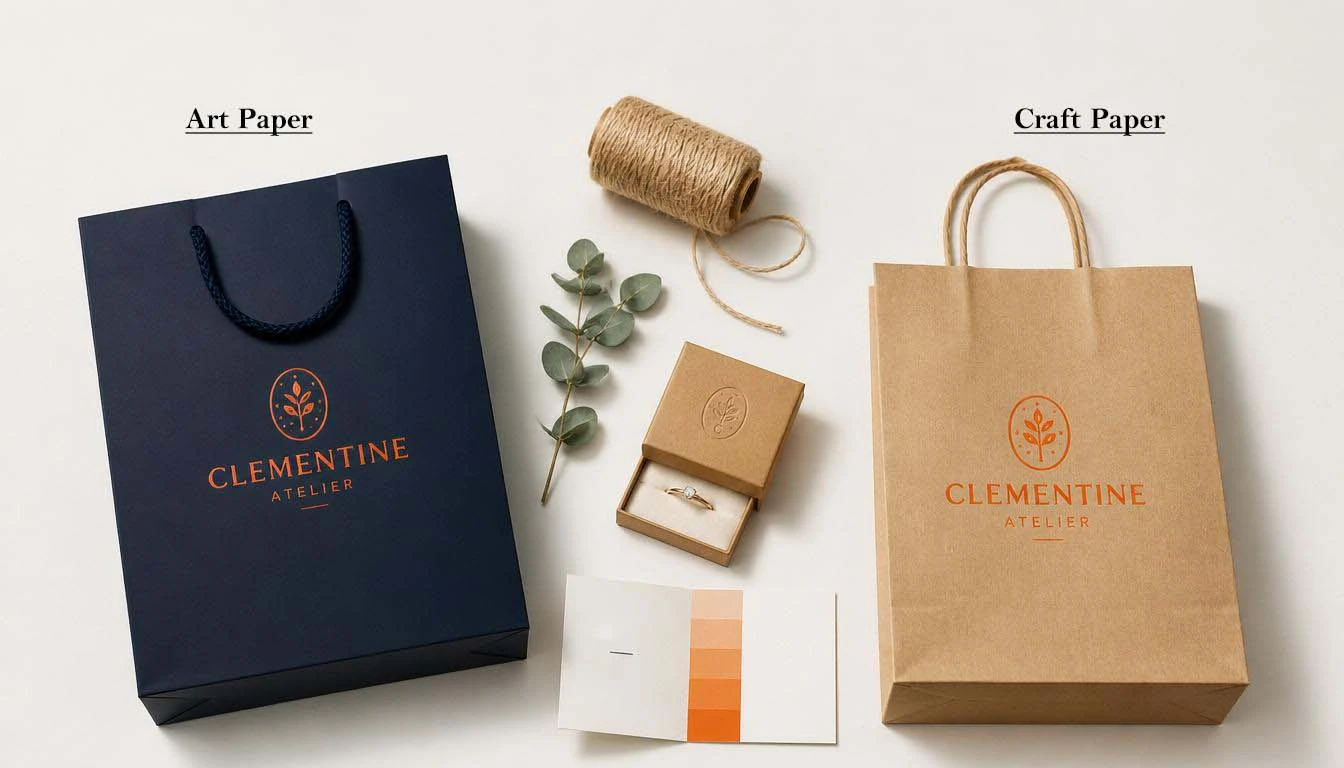
Art paper reads as polished and precise. It works for brands that want to project luxury, cleanliness, or technical sophistication.
Kraft paper reads as honest and natural. Customers associate it with handmade goods, organic products, and environmentally responsible businesses. It’s not that one is “better,” it’s that they tell different stories at first glance.
Technical Deep Dive: Manufacturing and Durability
The Kraft Process
The word “kraft” comes from the German word for strength. That’s not marketing, it’s a literal description of what the manufacturing process produces.
Kraft paper is made using the sulfate (chemical) pulping method. Wood chips are cooked in a chemical solution that breaks down lignin while keeping cellulose fibers mostly intact. Because the fibers stay long, the paper can flex and stretch without snapping. Short fibers, by comparison, break more easily under tension.
Virgin kraft (made entirely from fresh wood pulp) is stronger than recycled kraft. Recycled kraft contains shorter, already-weakened fibers, so it’s lighter duty. For shopping bags or packaging that will carry real weight, virgin kraft is the standard choice.
The Art Paper Coating
Art paper starts as a base paper or paperboard, then gets coated with a layer of fine clay mixed with adhesive binders. This coating fills in the tiny gaps between fibers, creating a smooth, non-absorbent surface.
There are two coating configurations: C1S (coated one side) and C2S (coated two sides).
- C1S is common for boxes and bags where only the outside needs printing. The uncoated inner side takes adhesive more easily.
- C2S is used when both sides need to show print, like in brochures or double-sided labels.
The coating is what allows offset and digital presses to lay down ink precisely without it spreading into the fibers. That’s why you can print a high-resolution photograph on art paper but not on uncoated kraft.
GSM vs. Caliper
GSM (grams per square meter) measures weight. Caliper measures physical thickness. These two numbers don’t move in sync between art paper and kraft paper.
A 150 GSM art paper and a 150 GSM kraft sheet weigh the same per square meter. But the art paper will feel stiffer and more rigid because its clay coating is denser. The kraft sheet will feel more flexible and slightly thicker in some cases because it contains more air between fibers.
This matters practically: a bag made from 150 GSM art paper will hold its shape better than one from 150 GSM kraft. But the kraft version will resist tearing more under load. For heavy shopping bags, kraft wins on function; art paper wins on structure and appearance.
Pro-Level Insights from Inside the Factory
The Fingerprint Test for Luxury Bags
Dark-colored art paper bags look sharp coming off the press. The problem is what happens after a customer carries them for ten minutes. Skin oils and friction leave marks on unprotected gloss surfaces that are immediately visible on black or navy art paper.
Matte lamination solves this. It adds a thin protective film that resists fingerprints and minor scuffs. If you’re specifying dark art paper for retail bags, matte lamination isn’t optional, it’s necessary.
The Silver Tarnish Warning
Natural kraft paper contains trace amounts of sulfur compounds left over from the chemical pulping process. Sulfur reacts with silver and causes tarnishing. If a jewelry brand wraps sterling silver pieces directly in natural kraft tissue or lines a box with uncoated kraft, the pieces can discolor within weeks.
The fix is to use sulfur-free tissue paper for anything touching silver directly, or swap to art paper for the inner lining. It’s a common enough issue that printers with jewelry clients know to flag it upfront. Printfo, a Bangladesh based printing press that handles packaging for a range of product categories, lists this as one of the first things they discuss when a jewelry brand comes in asking about kraft options.
Olfactory Branding
Both materials have a smell, and both can become a problem.
Kraft paper has a faint woody or earthy scent from the wood pulp. Most customers find it neutral or pleasant. Some brands actually lean into it as part of a natural product identity.
Freshly coated art paper can off-gas a mild chemical smell from the coating binders and any press inks. In a sealed box, this can build up. For food-adjacent packaging or products sensitive to odor contamination, ask your printer about low-VOC inks and let finished stock air out before final assembly.
Dot Gain and Color Saturation on Kraft
When ink is printed on uncoated kraft, the fibers absorb some of the ink and it spreads slightly beyond the intended dot. Printers call this “dot gain.” The result is that fine details blur and colors look darker and muddier than they appear in your design file.
This is why a full-color logo that looks great on art paper looks washed out or flat on kraft.
Two practical workarounds:
- Single-color or two-color printing. Bold, simple designs print cleanly on kraft without the muddiness issue. A single black or white logo on natural brown kraft looks intentional and sharp.
- Laser engraving or debossing. These techniques don’t use ink at all. They burn or press the design into the surface, giving a clean, tactile result that works well with the kraft aesthetic.
If your brand absolutely requires full-color printing on kraft, some vendors offer bleached or pre-coated kraft sheets that accept ink better, though they cost more and reduce some of the “natural” appearance.
Selection Matrix by Industry and Application
Luxury Retail and Fashion
Art paper is the industry standard here. Euro-tote bags with rope handles, Spot UV finishes on matte coated stock, foil stamping on rigid boxes. These finishes aren’t possible on kraft paper.
Typical spec: 157 to 200 GSM art paper with matte or gloss lamination, C1S, with reinforced rope handles glued internally.
Food and Takeout
Kraft paper is the practical choice. For food contact, the paper needs FDA certification (in the US) or equivalent food-grade certification in your market. Grease-resistant coatings are often applied to kraft to prevent oil from soaking through sandwich wraps, bakery bags, and takeout boxes.
Uncoated kraft handles grease poorly on its own, so confirm with your supplier what food-safe treatments are on the stock before ordering for food applications.
E-commerce and Shipping
Kraft is cheaper to buy, lighter per unit, and fully recyclable in most curbside programs. At volume, these factors add up. If you’re shipping 50,000 mailer bags per quarter, switching from art paperboard mailers to high-grade kraft mailers can reduce both material cost and shipping weight.
Customers have also started noticing and responding to kraft packaging positively in the unboxing experience, especially for brands with eco-friendly positioning.
The Jewelry Dilemma
Jewelry packaging is one of the few categories where the choice is genuinely hard.
Art paper with a ribbon pull-out box looks more expensive and photographs beautifully for product listings. But it comes with the sulfur risk for silver, higher cost, and less eco-friendly perception.
Kraft with a minimalist logo looks artisan and sustainable, photographs well in flat-lay shoots, and is cheaper per unit. But it doesn’t convey the same “premium” feel to customers who associate luxury with smooth white surfaces.
Most brands solve this by using kraft for outer packaging (mailer box, tissue wrap) and art paper or coated board for the inner ring box or product tray. You get both aesthetics at a reasonable cost per unit.
Cost Analysis: Beyond the Unit Price
Hidden Costs of Finishing on Art Paper
The base cost of an art paper bag is only part of what you’ll pay. If the spec includes matte lamination, foil stamping, Spot UV, die-cutting, and hand assembly (for rope handles), each step adds cost. On a 500-piece order, that finishing cost can exceed the base material cost.
Kraft bags are almost always simpler to finish. Twisted paper handles or flat die-cut handles are cheaper to attach than rope. The material itself takes less processing.
Shipping Weight and Volume Savings at Scale
Art paperboard is denser. At high volumes, the weight difference between paperboard and kraft mailers adds up on shipping invoices. This is most relevant for e-commerce brands shipping domestically or regionally.
One rough way to calculate: compare the per-unit weight of your current packaging against a kraft equivalent, then multiply by your annual shipment volume and current average carrier rate per gram. For brands shipping tens of thousands of units per year, the difference can be meaningful.
Market Price Fluctuations
Both materials are priced partly on wood pulp commodity markets and partly on energy costs (kraft processing is energy-intensive). Prices fluctuate, sometimes significantly, around events like wildfires, shipping disruptions, or energy price spikes in pulp-producing regions.
If you’re buying at volume, asking your supplier about price locking or forward contracts on material is worth a conversation. Regional printers like Printfo often purchase material in bulk for multiple clients, which can translate into more predictable pricing compared to placing small spot orders.
Sustainability and Compliance Standards
Certification Cheat Sheet
These three certifications come up often. Here’s what they actually mean:
FSC (Forest Stewardship Council): The paper comes from forests managed according to FSC’s environmental and social standards. This is the most recognized certification globally. If a brand claims sustainable sourcing, FSC is the most verifiable way to back that up.
PEFC (Programme for the Endorsement of Forest Certification): Similar to FSC but operates with different regional programs. Common in Europe. Equally legitimate, just less universally recognized in some markets.
ISO 14001: This certifies a company’s environmental management system, not the paper itself. It means the manufacturer has processes in place to monitor and reduce environmental impact. It says nothing about where the raw material came from.
For sourcing claims, FSC or PEFC on the material matters. For supplier vetting, ISO 14001 is a useful secondary signal.
Recyclability Pitfalls
Uncoated kraft paper is fully recyclable in standard curbside and commercial paper recycling. That’s straightforward.
Art paper without lamination is also recyclable in most programs, though the clay coating can slightly reduce fiber yield in recycling.
The problem is lamination. Plastic film lamination on art paper makes it non-recyclable in most paper streams. The plastic and paper can’t be separated at standard facilities. If recyclability matters to your brand (either genuinely or for marketing claims), you need to avoid plastic lamination or specify recyclable alternatives like aqueous coatings, which offer some protection but aren’t as durable.
Compostable lamination is available from some suppliers and is certified for industrial composting, though it won’t break down in home compost bins on most products currently available.
Alternative Fibers
Wood pulp is still dominant, but a growing number of specialty packaging products use fibers from agricultural residues like sugarcane bagasse, wheat straw, and bamboo.
These materials can produce papers with comparable strength to kraft and are grown on shorter crop cycles than trees. Availability varies by region, and unit costs are currently higher. For brands with strong sustainability positioning, they’re worth exploring, but the infrastructure for mass market use is still developing.
Frequently Asked Questions About Art Paper and Kraft Paper
What is the main difference between art paper and kraft paper?
Art paper has a clay-coated surface that allows precise, high-resolution printing. Kraft paper is uncoated, made from long wood fibers, and handles more weight without tearing. If you need sharp print quality, art paper. If you need load-bearing strength and a natural look, kraft.
Does kraft paper cause silver jewelry to tarnish?
Yes, it can. Natural (unbleached) kraft contains trace sulfur from the pulping process, and sulfur reacts with silver over time. Don’t use natural kraft tissue or lining in direct contact with sterling silver pieces. Sulfur-free tissue or art paper works for that inner layer.
Which paper is stronger for heavy shopping bags?
Virgin kraft, and it’s not particularly close. The long cellulose fibers in kraft pulp resist tearing under load in a way that coated art paper doesn’t. Kraft can handle 10 to 15 kg without lamination; art paper at the same GSM needs extra finishing to get near that.
Can you print high-quality photos on kraft paper?
Not really. The uncoated surface absorbs ink unevenly, which blurs fine detail and flattens color. Simple, bold designs in one or two colors work well on kraft. For photo-level print quality, you need a coated surface.
Is art paper recyclable if it has a glossy lamination?
Usually no. Plastic lamination film bonds to the paper and most facilities can’t separate the two materials. Unlaminated art paper goes into standard paper recycling without issue. If recyclability matters, aqueous coatings offer some surface protection without the plastic film problem.
Why is kraft paper usually brown while art paper is white?
The brown comes from lignin and residual compounds that stay in the fiber after kraft processing. Bleached kraft removes those compounds and comes out white. Art paper takes that bleached base stock further and adds a clay coating to create the bright, smooth printing surface.
What is the ideal GSM for a luxury retail paper bag?
Most luxury retail bags sit between 157 and 210 GSM coated art paper. Larger bags carrying multiple items go up to 250 GSM. Below 150 GSM, the bag tends to buckle at the base corners when loaded, which undercuts the premium look you’re paying for.
Why does my art paper bag have a chemical smell?
It’s off-gassing from the clay coating binders and the press inks. Freshly printed stock sealed in a warehouse or box concentrates the smell. It clears on its own with a few days of ventilation. Low-VOC inks and water-based coatings reduce it at the source, so it’s worth asking your printer what they’re running if the smell is a problem for your product.